
Most of the headaches I see in clients aren't really headaches.
They're shoulder pain that's traveled north.
There's a piece of bodywork knowledge that almost nobody outside the field knows about, and it explains why this happens. It's called referred pain.
Here's the idea. A tight muscle doesn't always hurt where the muscle is. It can send pain to a completely different part of the body. Sometimes a few inches away. Sometimes across the body. The nerves carrying the signal don't always know where the trouble started. The brain interprets the signal and shows up with pain in a place that, anatomically, makes no sense.
Until you learn the maps.
The upper trapezius is the muscle that sits on top of your shoulder, between your neck and the bony point at the end. It's the muscle that hunches up when you're stressed. The one that's quietly working overtime any time you're at a laptop. When that muscle holds tension long enough, it stops saying "my shoulder hurts." It says "I have a headache at my temple, behind my eye, and along the angle of my jaw."
That's the most common headache pattern there is. And it almost never gets pointed at the shoulder.
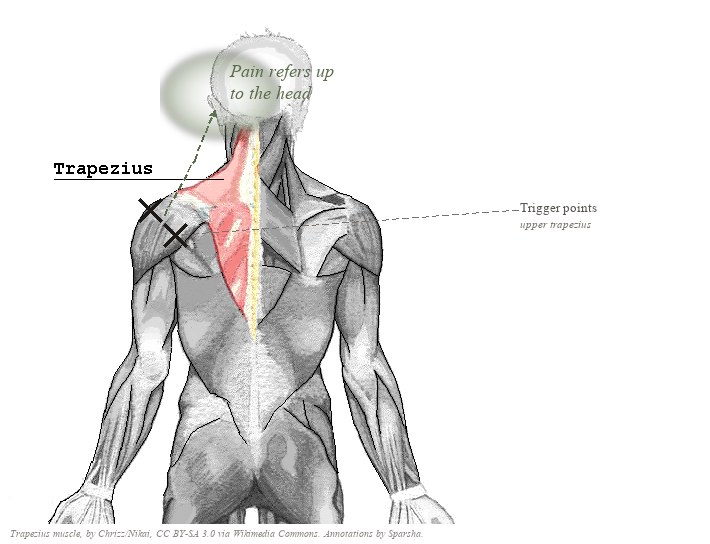
A handful of muscles quietly run the show on tension headaches.
Upper trapezius. The most reliable headache referrer in the body. Sends pain to the temple and behind the eye.
Levator scapulae. Runs from the base of the skull down the side of the neck to the inner edge of the shoulder blade. When it locks, you can't turn your head and you get a deep ache at the corner where neck meets shoulder.
The suboccipitals. A cluster of small muscles right under the base of your skull, holding your head up against gravity all day. When they lock, you get the headache that feels like a band wrapping from the back of the skull around to the forehead.
Sternocleidomastoid. The rope of muscle on the side of your neck, the one you can grab and feel. Refers pain to the forehead, behind the ear, sometimes into the cheekbone.
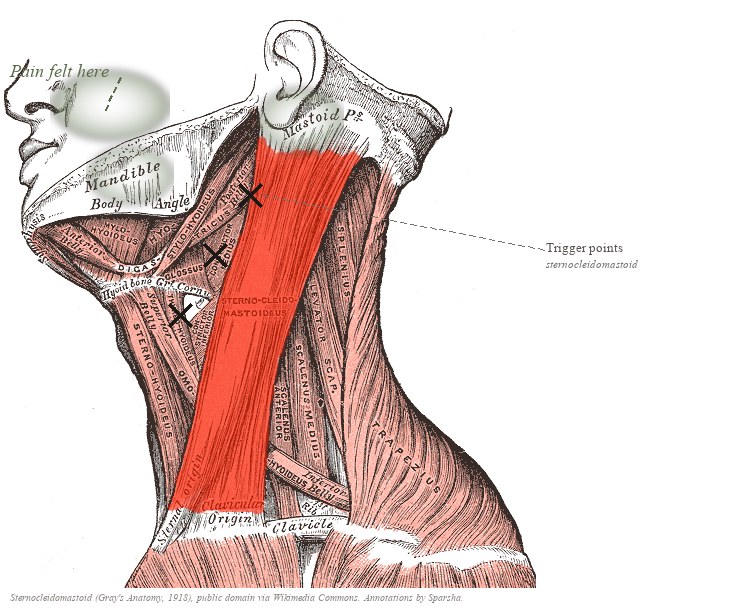
Most tension headaches are some combination of these.
When I work this area in a session, I'm not chasing the headache. I'm tracing the muscles I can feel are loaded and asking them to let go. The headache usually follows.
What you can try this week.
One. Stretch your chest, not your neck. Stand in a doorway, forearm against the frame, walk your body forward until you feel the front of your shoulder open. Thirty seconds each side. Tight chest pulls your shoulders forward, which loads the back of the neck, which feeds everything I just listed. The fastest way to ease the back is to open the front.

Two. Raise your monitor. If your screen is below eye level, your head spends all day forward of your shoulders. Stack books under it until the top of the screen is at your eye line. This one change is responsible for more headache relief than any product I could name.
When to see somebody.
A bodyworker, if the headaches are a regular pattern and you can feel tight neck and shoulder muscles. That's what this is for.
A physical therapist, if the headaches come with neck weakness, posture you can't seem to correct, or pain that doesn't shift with manual work.
A doctor, immediately, if a headache comes on suddenly and is the worst you've ever had, if it comes with vision changes, fever, a stiff neck, weakness, or a change in alertness. That's a different category of headache, and it isn't muscular.
Most of what shows up as a tension headache is reachable. It's a body asking for adjustment, not a brain doing something wrong.
The pain is real. It's just living somewhere you didn't expect.