Notice your jaw right now.
Are your teeth touching?
For most people, they are. Not chewing. Not stressed in any way you'd describe as stress. Just gently engaged.
The jaw quietly holds tension we've stopped registering. That's what a tired jaw is. Not a problem with a joint. A muscle group that's been working twelve hours a day for years, never told it was off shift.
This is part of a series on referred pain. A tight muscle doesn't always hurt where the muscle is. The jaw is one of the cleanest examples in the body, and one of the least obvious. Pain in a tooth that the dentist can't find. Headaches at the temple. Fullness in the ear. All of them, sometimes, are the muscle in front of your ear.
The TMJ is the hinge in front of your ear where the lower jaw meets the skull. The most-used joint in the body. You use it to chew, to talk, to swallow, to clench through stress that doesn't have a name. By the time someone arrives with a TMJ problem, the muscles have usually been holding for years.
The muscles, almost always, are the actual issue.
The masseter. The thick muscle on the side of the jaw. The one that pops out when you clench. The biggest single contributor to jaw pain. Refers into the upper teeth. The lower teeth. The ear. The angle of the jaw. The cheekbone. Most tooth pain that gets cleared by the dentist was here all along.
The temporalis. Fan-shaped, on the side of the head, above and in front of the ear. Lifts the jaw to close the mouth. Refers into the temple. Behind the eye. The upper teeth. The muscle behind "I have a headache and my upper teeth ache too."
The pterygoids. Two pairs, deeper inside the jaw behind the cheekbone, not reachable from outside the mouth. Refer to the TMJ joint itself. To the back of the mouth. Sometimes the ear. These are the muscles a trained specialist works on internally when external work hasn't moved things.
The SCM and digastric, side and underside of the neck. Not the primary suspects, but they carry the load of a chronically tense jaw and usually need attention before the jaw fully lets go.
What loads these muscles. Grinding at night. Gum chewing. Holding the phone with your shoulder. Clenching during workouts. Mouth breathing. Stress that doesn't have a name. The jaw is the body's stress vault. Things get put there.
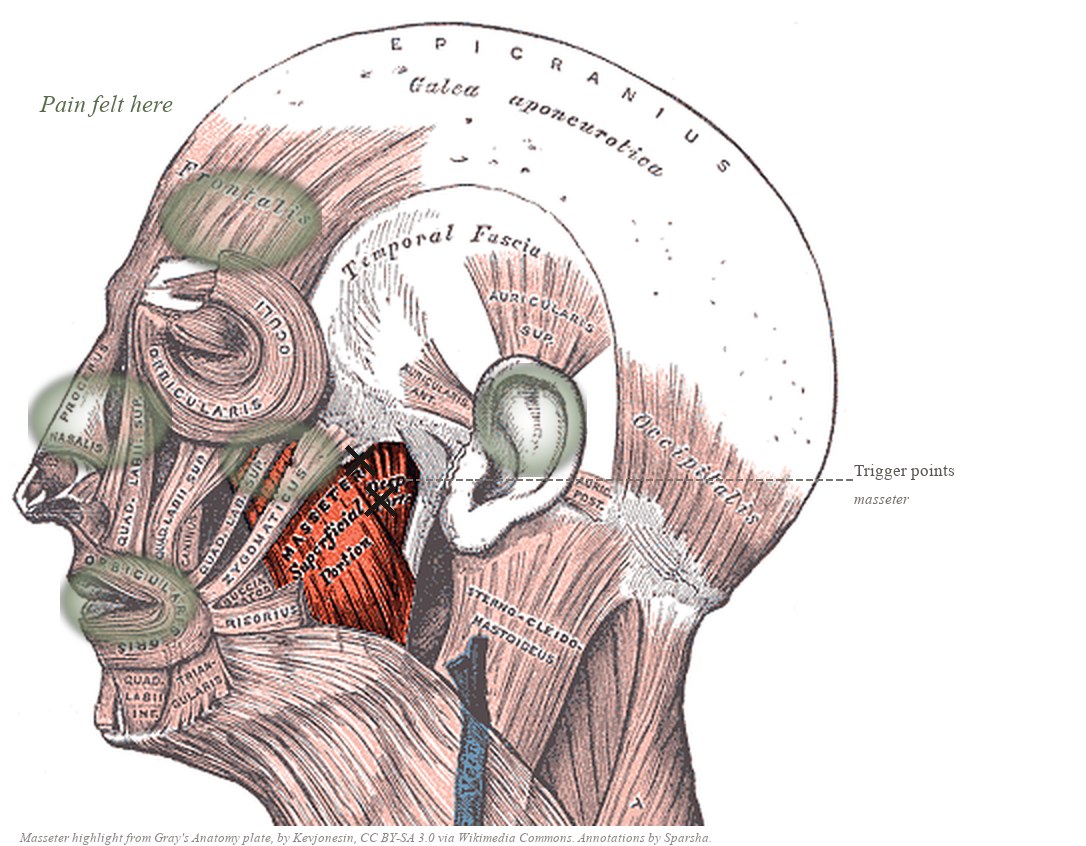
What I do, in a session. The masseter and temporalis externally. With consent and clear conversation first, sometimes the pterygoids and the inner masseter intra-orally with a gloved finger. Intra-oral work feels unusual. It produces some of the most dramatic relief I've seen for long-standing jaw issues. Nothing happens that the client hasn't talked through and agreed to.
Two things you can try this week.
Self-release on the masseter. Clench your teeth gently. Feel the muscle pop out below the cheekbone, in front of the ear. With light pressure, place a fingertip on the bulkiest part. When you find a sore spot, hold. Thirty seconds. Don't dig. Don't grind. Just hold. The muscle softens under quiet, sustained contact better than under any kind of deep work.
Let your teeth float apart. The resting position of a healthy jaw is: lips together, teeth apart, tongue gently against the roof of the mouth behind the front teeth. Most of us don't do this. Notice your jaw three times a day. Each time, soften. Within a week, the muscles learn neutral again.
When to bring in a professional.
A bodyworker, if there's jaw tension, headaches, ear fullness, or tooth pain that a dentist has already cleared.
A dentist, if you're grinding at night (they can usually tell from wear patterns), or if there are bite issues that need ruling out first.
A TMJ specialist or orofacial pain specialist, if the jaw clicks with pain, locks, or limits how wide you can open, especially after months of self-care and bodywork haven't moved things.
A doctor, immediately, if jaw pain comes on suddenly with chest pain, shortness of breath, or pain down an arm. That can be a referral from the heart. Also immediately for sudden facial weakness or inability to open the mouth at all.
A tired jaw is the body's stress vault asking to be emptied. The work isn't to force it open. The work is to let the rest of the system feel safe enough that the jaw stops needing to hold.